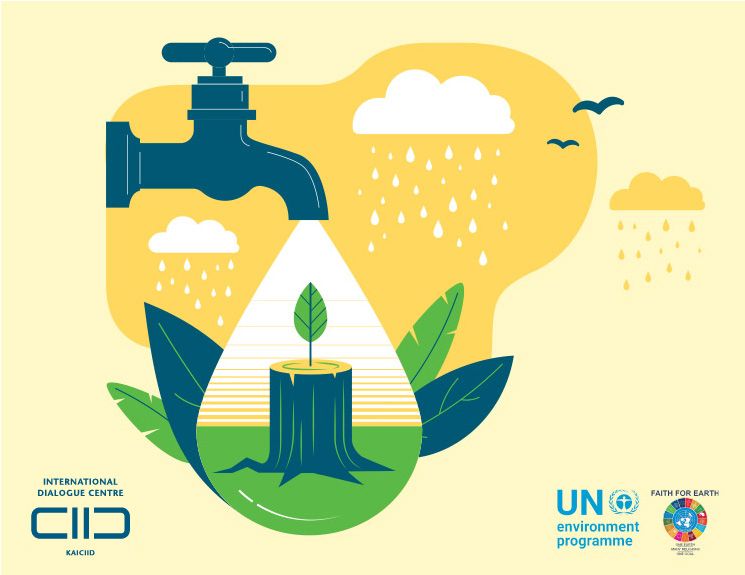
Faith and Water
Self-Paced E-Learning Course
-
- At the end of this course, participants will:
-
Understand the major environmental challenges of water security and scarcity, water-related natural disasters, water source pollution and marine and freshwater ecosystem degradation.
-
Recognise how religions relate to water in their sacred teachings and spiritual practices, offering an opportunity to reflect on the great degree of interfaith overlap.
-
Have knowledge of how FBOs are taking steps and implementing initiatives to alleviate the current global water crisis.
-
Have guidelines and resources to engage with in order to more effectively address different water issues.
Certification
A Certificate of Completion will be issued to participants who achieve a minimum total score of 70%.
About UNEP
Since its inception in 1972, the United Nations Environment Programme (UNEP) has been the global authority that sets the environmental agenda, promotes the coherent implementation of the environmental dimension of sustainable development within the United Nations system and serves as an authoritative advocate for the global environment. UNEP’s mission is to provide leadership and encourage partnerships in caring for the environment by inspiring, informing, and enabling nations and peoples to improve their quality of life without compromising that of future generations. UNEP works closely with its 193 Member States and representatives from civil society, businesses, and other major groups and stakeholders to address environmental challenges through the UN Environment Assembly, the world’s highest-level decision-making body on the environment.
Course contents
The course effectively demonstrated how faith communities can play a leading role in water conservation, particularly through rituals, community engagement, and advocacy. As a climate adaptation student, I especially valued the connection to real-world initiatives, such as interfaith dialogues promoting sustainable water use in drought-prone regions.
Nanda Ridho, Course Participant, Indonesia